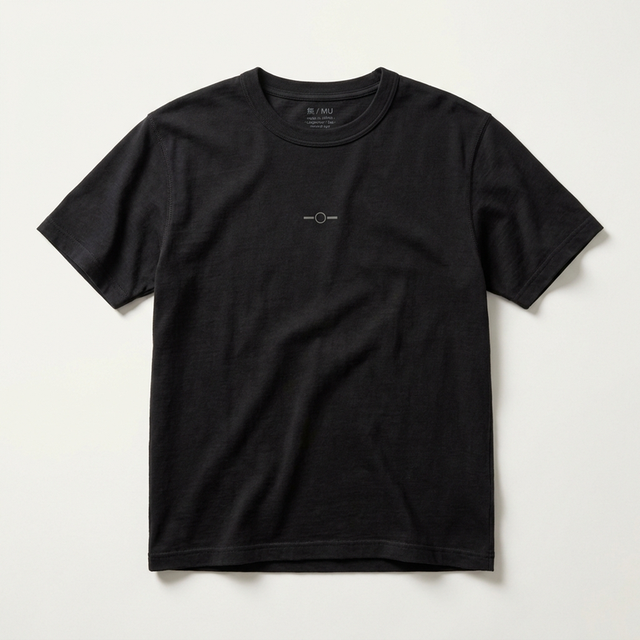
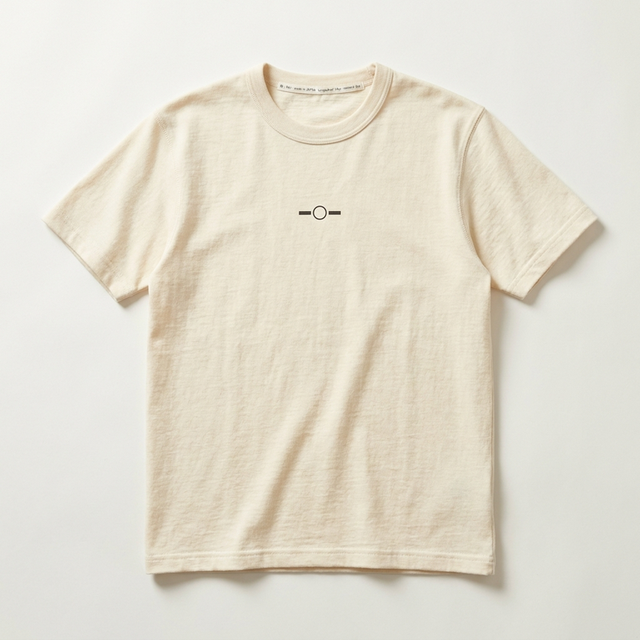
The Wakayama loopwheel knits maybe one roll a day. Gravity drops the needles, so the yarn never gets over-tensioned. Oil stays in the fiber, the cotton doesn't thin out, and it doesn't slump after fifty washes. Modern lines run 30× faster — and lose exactly what we're trying to keep. So we picked 14oz.
The Teshikaga mineral dye uses volcanic ash and iron mordant pulled from around Lake Kussharo. No synthetic dye, so the black isn't uniform — every piece has slightly different depth. This isn't a defect. It's the physics of minerals settling into fiber. Even within one lot, no two blacks are strictly identical.
Sewing is flatlock at a long-running Hyogo factory. Shoulder to sleeve, side to hem — no seam allowance against the skin. Because the allowance isn't folded back, the thread won't break with age. The same structure that keeps fifty-year vintage tees alive, baked in from day one.
Every MU edition ships with an NFC tag and inner serial embroidery. This edition adds a 100-year repair coupon: if the fabric frays, the dye fades, or a seam breaks, send it back to Teshikaga. We'll fix it. Child to grandchild, the coupon transfers via NFC.
Packaging is a wood box from Hokkaido yew (onko) — a slow-growing conifer measured in centuries. The box itself lasts 100 years. For a tee meant to outlive the owner, nothing else made sense.